

How Much Does an AI-Powered Mobile App Cost in 2026? React Native Rates, Bangladesh vs US
- By Md. Emamul Mursalin
- Updated
- 10 min read
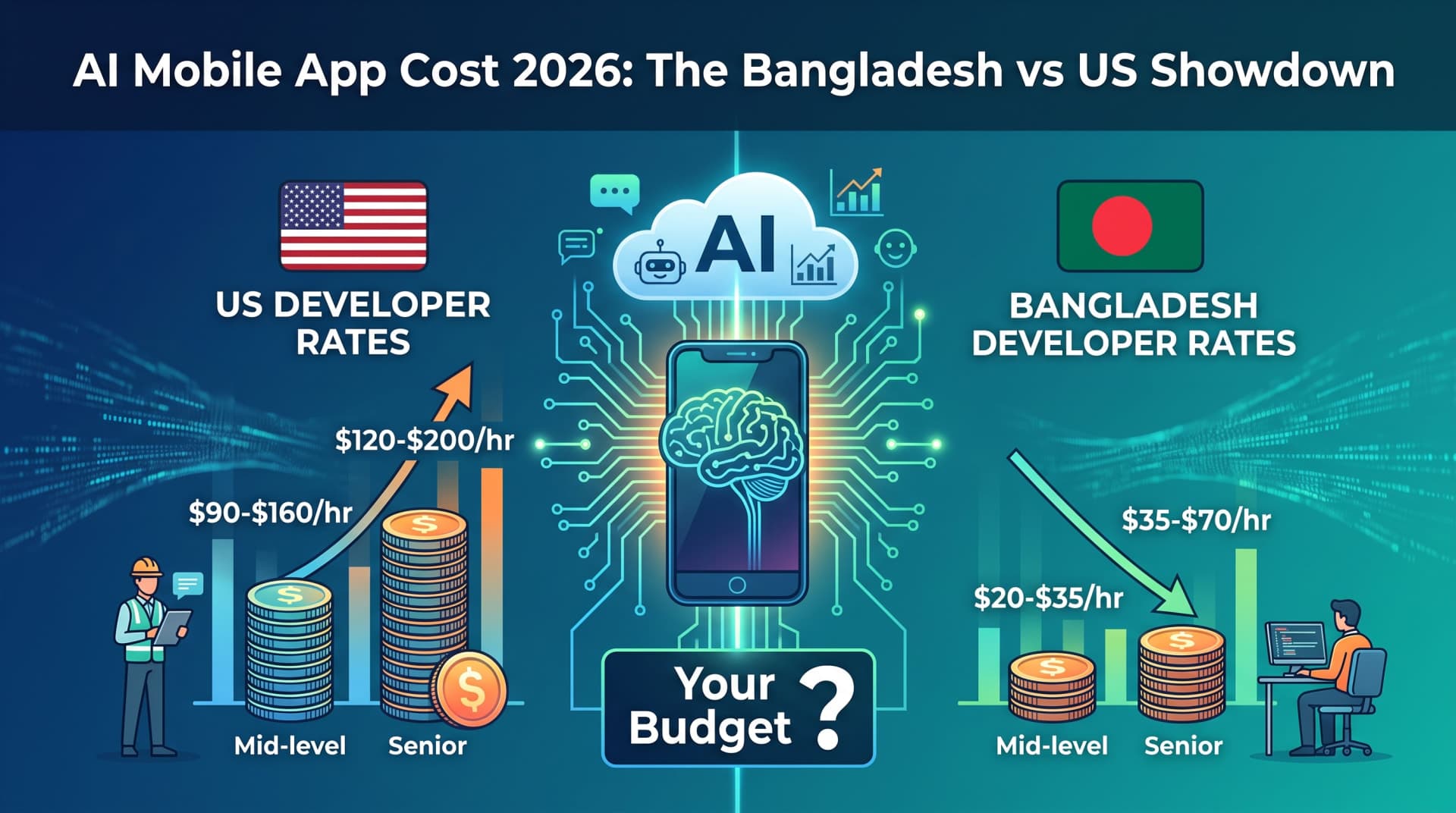
AI app development cost React Native in 2026: a focused AI-powered app with one or two LLM features costs $4,000-15,000 when built by a senior freelance developer in Bangladesh, and $40,000-150,000 from a US or UK agency. Add 20-40% over a non-AI app of the same size, plus a monthly API bill that starts around $50 and scales with users. I am Md. Emamul Mursalin, a freelance AI product developer in Rajshahi, Bangladesh, and I build these apps with React Native and Expo for clients in the US, UK, and EU. This is how I would budget one. ## What "AI-powered" actually adds to a mobile app budget Most of an AI app is still a normal app: auth, navigation, a backend, push notifications, App Store and Google Play submission. The AI part is usually one of these: - **Chat or assistant**: streaming responses from an OpenAI, Claude, or Groq model, with conversation history - **Voice**: speech-to-text (Whisper or a device model), an LLM in the middle, text-to-speech out - **Camera and vision**: photo in, structured description or classification out - **Personalization**: recommendations, summaries, or coaching generated from user data - **On-device inference**: a small model running offline for privacy or latency Each of those is a week or two of extra work in a well-run project, which is why the 20-40% premium that agency cost guides quote is roughly right. The expensive part is not calling the API. It is the plumbing around it: streaming UI, retries, cost caps, prompt versioning, and evals so you can prove the feature works before you ship it. ## The 2026 cost table: Bangladesh vs US These are ranges I see in September 2026 from published agency guides and my own quotes. Hourly rates for senior Bangladeshi developers sit at $15-35 for generalists and $45-75 for the expert tier; US agencies bill $100-200 an hour. | App scope | Senior freelancer, Bangladesh | US / UK agency | Typical timeline | |---|---|---|---| | AI feature added to an existing RN app | $1,300-3,000 | $10,000-25,000 | 2-4 weeks | | AI MVP: auth, one AI feature, backend, both stores | $4,000-8,000 | $40,000-80,000 | 6-9 weeks | | Full AI product: voice or vision, subscriptions, admin | $10,000-20,000 | $100,000-200,000 | 10-16 weeks | | Enterprise: offline on-device model, compliance, SSO | $20,000+ | $200,000+ | 4-6 months | My own fixed-price tiers for [AI-powered mobile apps](/pricing#ai-mobile-apps) map onto the first three rows: $799 for a 3-4 week starter build, $2,299 for a 6-9 week professional build, and $3,799 for a 10-16 week enterprise build. In my experience most founders land in the middle tier. The reason the US column is 8-10x higher is not that agencies are slow. It is that you are paying for a project manager, a designer, a QA engineer, and an account manager on top of the developer. When you hire a senior freelancer directly, you get one person who does design handoff, development, and release, and you communicate with that person. Whether that trade is right for you depends on how much hand-holding you need. ## Where the money actually goes A $2,299 professional build breaks down roughly like this in my process: 1. **Discovery and scoping (5%)**: one call, a written scope, a Figma or wireframe review. I will cut features here, because a 6-week app cannot have twelve screens. 2. **App shell (25%)**: Expo project, Expo Router navigation, auth with Supabase or a NestJS backend, state, theming. This is where React Native saves you money: one codebase, two stores. 3. **AI feature (35%)**: the backend endpoint that calls the model, streaming to the client with the Vercel AI SDK or a custom Socket.io channel, prompt design, a small eval set, cost logging per user. 4. **Backend and data (20%)**: PostgreSQL with Prisma, usage tracking, rate limiting so one user cannot burn your API budget. 5. **Release (15%)**: EAS Build, TestFlight and Play internal testing, store listings, crash reporting, one round of fixes after real-device testing. Notice that nothing above says "training a model." Almost no startup app needs a custom-trained model in 2026. If a developer quotes you for one, ask why a hosted model plus retrieval will not do. ## The monthly bill nobody puts in the quote Development cost is one-time. AI apps have a recurring line that scales with usage, and founders are regularly surprised by it. As of September 2026 the small models are inexpensive: OpenAI's GPT-5.4 Mini is about $0.75 per million input tokens and $4.50 per million output, Claude Haiku 4.5 is $1 and $5, and GPT-5 Nano is $0.05 and $0.40. Speech-to-text and text-to-speech are priced separately by the minute. For a chat-style feature averaging 2,000 tokens per exchange, the math looks like: - 100 active users, 10 exchanges a day each: roughly $30-90 a month - 1,000 active users: $300-900 a month - 10,000 active users: $3,000-9,000 a month, at which point you switch to prompt caching, a smaller model for easy requests, or on-device inference Add Expo EAS (free tier is enough for early apps; paid plans start at a few tens of dollars a month), a Supabase or Postgres host, and Apple's $99 a year developer program. Published integration guides put total API fees for a small SaaS at $50-3,000 a month depending on user count, which matches what I see. I build a cost dashboard into every AI app I ship so the founder sees dollars per user per day from week one. It is a small amount of work and it prevents the most common post-launch panic. ## Expo or bare React Native, and does it change the cost? Use Expo. In 2026 there is very little reason for a new app to start bare. Expo SDK 56 (released May 2026) runs on React Native 0.85 with the New Architecture always on, EAS handles builds and over-the-air updates, and native modules are available through config plugins. Every AI library I care about, including react-native-executorch for on-device models and the Vercel AI SDK for streaming, works in a managed Expo project. The cost impact is real: Expo removes a week or more of native build setup and a lot of ongoing maintenance. The only time I recommend bare React Native is when an app depends on a native SDK with no Expo config plugin, and that is rarer every year. ## How AI features change the timeline Founders sometimes ask why an AI feature takes two weeks when "it is just an API call." A checklist of what has to exist before I will let an AI feature ship: - [ ] Streaming UI that handles partial responses, cancel, and retry - [ ] A backend endpoint so the API key never lives in the app bundle - [ ] Per-user rate limits and a hard monthly cost ceiling - [ ] A 20-50 example eval set with expected outputs, run on every prompt change - [ ] Graceful fallback when the model provider is down or slow - [ ] Logging of prompt version, tokens, latency, and cost per request - [ ] A privacy note in the app and store listing explaining what is sent to which provider Skip any of these and you will pay for it in month two. The [Iqtidah Sunnah Tracker](/projects/iqtidah-sunnah-tracker), a React Native app I shipped, is a good example of keeping the AI surface small and reliable rather than sprinkling generative features everywhere. ## What you should ask a developer before you sign A few questions that separate someone who has shipped AI apps from someone who has watched a tutorial: 1. Which model would you use for this feature, and why not a cheaper one? 2. How do you stop one user from spending $500 of API credit in a day? 3. Show me an app you shipped to both stores. Can I download it? 4. Do you use EAS Build, and who owns the Apple and Google developer accounts? (Answer: you do.) 5. What happens to my data: what goes to the model provider, and is it used for training? If you are hiring from Bangladesh specifically, I have written a practical guide on contracts, IP assignment, and paying via Payoneer or bank wire in [How to Hire a Freelance Developer from Bangladesh Directly](/blog/hire-freelance-developer-from-bangladesh-directly). The short version: get an IP assignment clause, own your own accounts, and expect async communication with a UTC+6 overlap on US mornings and evenings and the full UK afternoon. ## AI app development cost React Native: the decision To sum up the AI app development cost React Native question for 2026: budget $4,000-8,000 for an AI MVP from a senior Bangladeshi freelancer or $40,000-80,000 from a US agency, add 20-40% over a non-AI app for the AI plumbing, and plan for a monthly API bill that starts small and grows with users. Choose the freelancer route when you can write a clear brief and want one senior person accountable end to end. Choose the agency when you need a full team and in-person process. Either way, insist on cost caps, evals, and a fallback before launch. ## FAQ ### How much does it cost to build an AI app with React Native? In 2026, an AI-powered React Native MVP costs $4,000-8,000 from a senior freelance developer in Bangladesh and $40,000-80,000 from a US or UK agency. Adding a single AI feature to an existing app runs $1,300-3,000 offshore. Expect a recurring API bill of $50-900 a month for the first thousand users on top of that. ### Is React Native good for AI apps? Yes. React Native with Expo gives you one codebase for iOS and Android, streaming UI with the Vercel AI SDK, and on-device inference through libraries like react-native-executorch and llama.rn. The AI logic lives on your backend or in a small on-device model, so the framework choice mostly affects build speed and cost, where React Native wins. ### How much does app development cost in Bangladesh? Senior Bangladeshi developers charge $15-35 an hour, with the expert tier at $45-75. A simple non-AI app costs $2,000-6,000; an AI-powered app typically $4,000-15,000 depending on features and whether you need voice, vision, or subscriptions. Local agencies quote higher than freelancers because they include project management and QA staff. ### How long does it take to build a mobile app MVP? A focused AI mobile MVP takes 6-9 weeks with one senior developer: two weeks for the app shell and auth, two to three for the AI feature and backend, one for release and store review. A starter build with an existing design can ship in 3-4 weeks. Store review adds a few days on each platform. ### Should I use Expo or bare React Native? Use Expo for any new app in 2026. Expo SDK 56 runs on React Native 0.85 with the New Architecture enabled, EAS Build handles native builds, and config plugins cover almost every native module. Go bare only if a required native SDK has no Expo support, which is increasingly rare and worth confirming before you decide. ## Work with me If you want a fixed quote for an AI-powered mobile app, [book a call](/appointments) or [start a professional-tier project](/contact?service=ai-mobile-apps&tier=professional). You can see the full scope of each tier on the [AI mobile apps professional service page](/services/ai-mobile-apps-professional), and read about how I work with remote clients on my [React Native developer page](/hire/react-native-developer-bangladesh).
Written by
Md. Emamul Mursalin
Free consultation
Building something like this?
I'm a freelance AI product developer in Rajshahi, Bangladesh, working remotely with clients worldwide. A free 30-minute call is enough to scope it.
Book a free 30-min callKeep reading
Related articles

- Hiring Guides
- 12 min read
Code Audit Cost in 2026: Real Prices From $249 to $20,000 and What Each One Buys
A code audit costs anywhere from $249 to $20,000+ in 2026. Here are published prices from real providers, what drives the number, and how to pick the tier you actually need.
- Developer Tools
- 10 min read
Best VS Code Extensions for NestJS in 2026: 13 That Earn Their Place
The VS Code extensions I actually run on NestJS projects in 2026, with install counts, what each one does, which popular ones are abandoned, and a copy-paste extensions.json.
- Developer Tools
- 11 min read
Nestor: A NestJS VS Code Extension That Puts the Docs and Design Patterns on Hover
Nestor is a free NestJS VS Code extension: 136 pages of official docs on hover, fully offline, plus Gang of Four pattern detection for your own classes. Here is what it does and why I built it.