

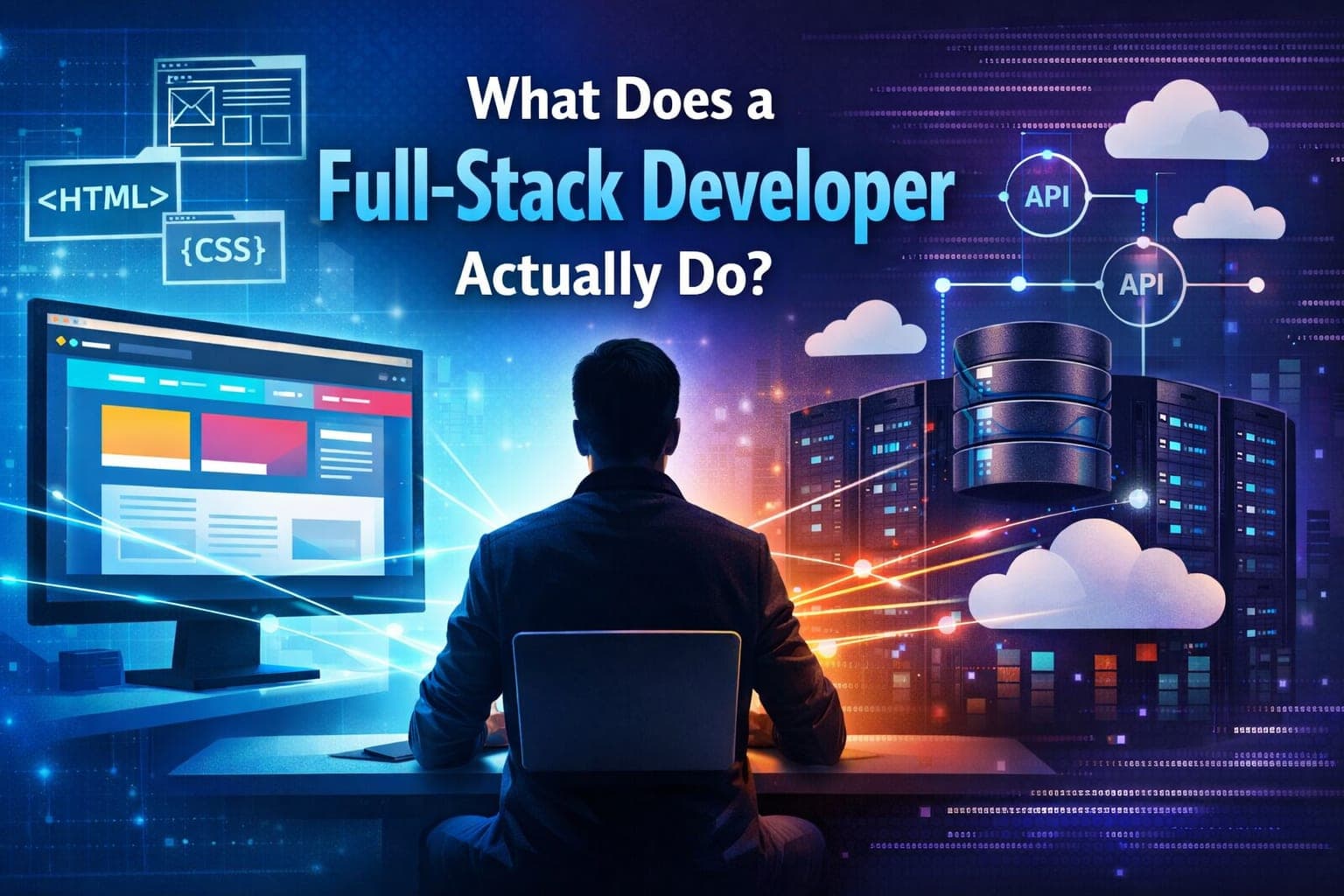
What Does a Full-Stack Developer Actually Do?
- By Md. Emamul Mursalin
- Updated
- 4 min read
The Short Answer
A full-stack developer builds both the frontend (what users see and interact with) and the backend (servers, databases, APIs) of a web application. Instead of specializing in one layer, they work across the entire stack.
That does not mean they know everything equally well. Most full-stack developers lean toward either frontend or backend, but they are comfortable enough on both sides to ship a complete product.
Frontend: The Part Users See
The frontend is the user interface. Everything you click, scroll, type into, or look at on a website is frontend code. A full-stack developer working on the frontend will:
- Build page layouts and components using React, Next.js, or Vue
- Handle user interactions (form submissions, navigation, animations)
- Make the site responsive so it works on phones, tablets, and desktops
- Connect the UI to backend APIs to display and send data
- Optimize performance so pages load fast
The tools I use for frontend work: React, Next.js, TypeScript, and Tailwind CSS. These cover about 90% of what modern web apps need on the client side.
Backend: The Part Users Do Not See
The backend is where data lives and business logic runs. When you sign up for an account, make a payment, or load your dashboard, that is the backend doing its thing. Backend work includes:
- Building REST or GraphQL APIs
- Designing database schemas (what data to store and how)
- Writing business logic (pricing calculations, user permissions, notifications)
- Setting up authentication and authorization
- Handling file uploads, email sending, and third-party integrations
My backend stack: Node.js with NestJS, Prisma ORM, and PostgreSQL. For simpler projects, Express works fine too.
DevOps: The Glue That Holds It Together
Most full-stack developers also handle basic deployment and infrastructure. You do not need to be a DevOps engineer, but you should know how to:
- Deploy to Vercel, AWS, DigitalOcean, or similar platforms
- Set up CI/CD pipelines so code gets deployed automatically on push
- Use Docker to containerize applications
- Configure environment variables, DNS, and SSL certificates
- Monitor logs and debug production issues
When Should You Hire a Full-Stack Developer?
A full-stack developer is the best choice when:
- You are building an MVP. One person who can handle everything moves faster than coordinating a team of specialists.
- Your budget is limited. Hiring one full-stack developer costs less than hiring a frontend dev, a backend dev, and a DevOps engineer separately.
- You need a technical co-founder type. Someone who can make architecture decisions, build the product, and iterate quickly.
- Your project is small to mid-size. Landing pages, web apps, SaaS products, and e-commerce stores are all well within the scope of a single full-stack developer.
When You Might Need Specialists Instead
Full-stack is not always the answer. Consider separate specialists when:
- Your product needs heavy custom UI/UX work (hire a dedicated frontend developer or designer)
- You are dealing with complex infrastructure at scale (hire a DevOps or platform engineer)
- You need deep expertise in machine learning, data engineering, or mobile development
Skills That Separate Good Full-Stack Developers from Great Ones
Technical skills are table stakes. What separates a good developer from a great one:
- They ask good questions. Before writing any code, they make sure they understand the problem.
- They ship working software. Not just code that compiles, but features that real users can use.
- They communicate clearly. They can explain technical decisions to non-technical people without jargon.
- They know when to keep it simple. Over-engineering is a bigger problem than under-engineering.
- They keep learning. The web moves fast. A developer who stopped learning three years ago is already behind.
I have been working as a freelance full-stack developer for several years now, building web applications for clients across multiple countries. If you need help with your project, check out my services or book a free call.
Written by
Md. Emamul Mursalin
Freelance AI Product Developer
Free consultation
Building something like this?
I'm a freelance AI product developer in Rajshahi, Bangladesh, working remotely with clients worldwide. A free 30-minute call is enough to scope it.
Book a free 30-min callKeep reading
Related articles

- Hiring Guides
- 12 min read
Code Audit Cost in 2026: Real Prices From $249 to $20,000 and What Each One Buys
A code audit costs anywhere from $249 to $20,000+ in 2026. Here are published prices from real providers, what drives the number, and how to pick the tier you actually need.
- Developer Tools
- 10 min read
Best VS Code Extensions for NestJS in 2026: 13 That Earn Their Place
The VS Code extensions I actually run on NestJS projects in 2026, with install counts, what each one does, which popular ones are abandoned, and a copy-paste extensions.json.
- Developer Tools
- 11 min read
Nestor: A NestJS VS Code Extension That Puts the Docs and Design Patterns on Hover
Nestor is a free NestJS VS Code extension: 136 pages of official docs on hover, fully offline, plus Gang of Four pattern detection for your own classes. Here is what it does and why I built it.