
Completed case study
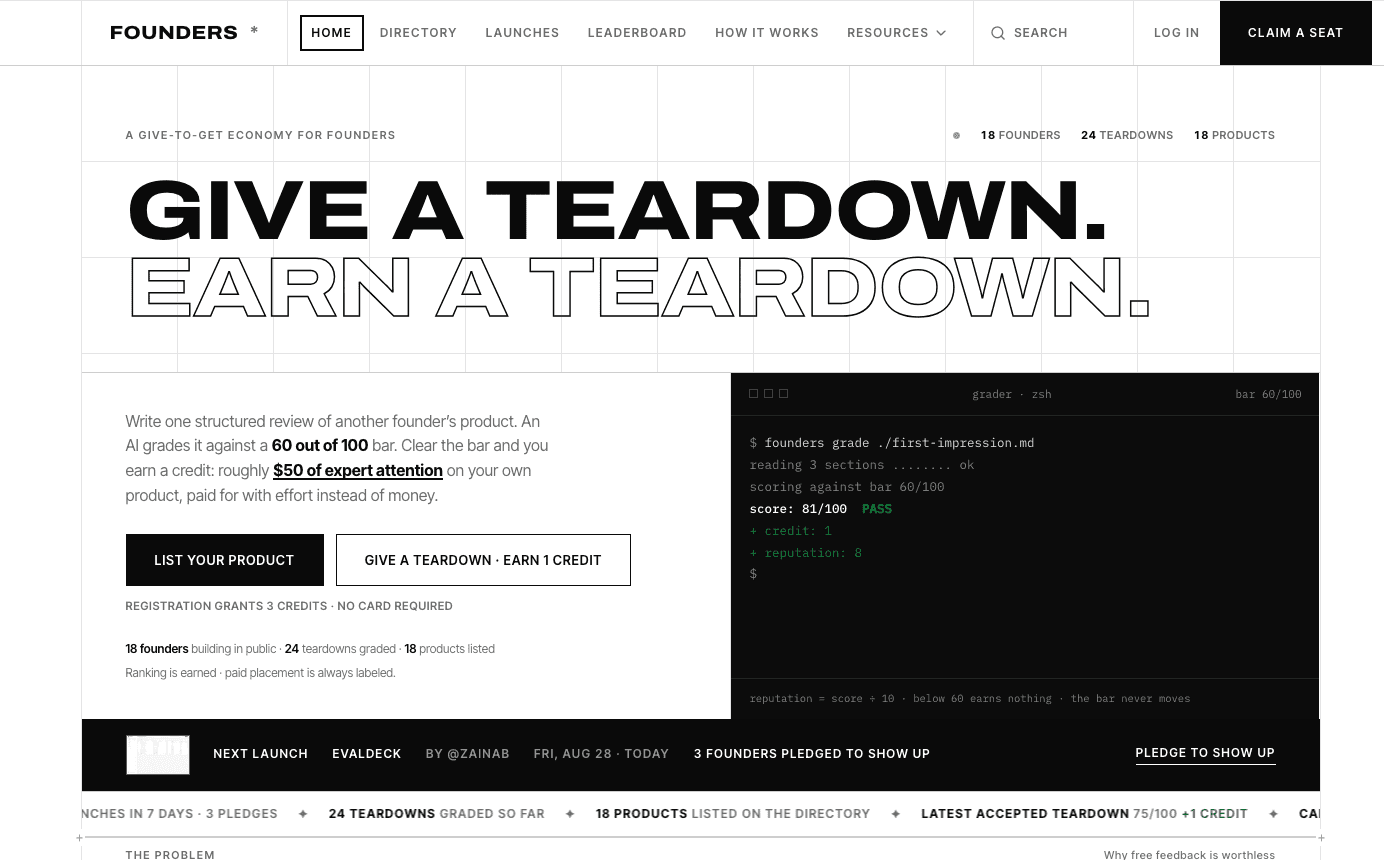
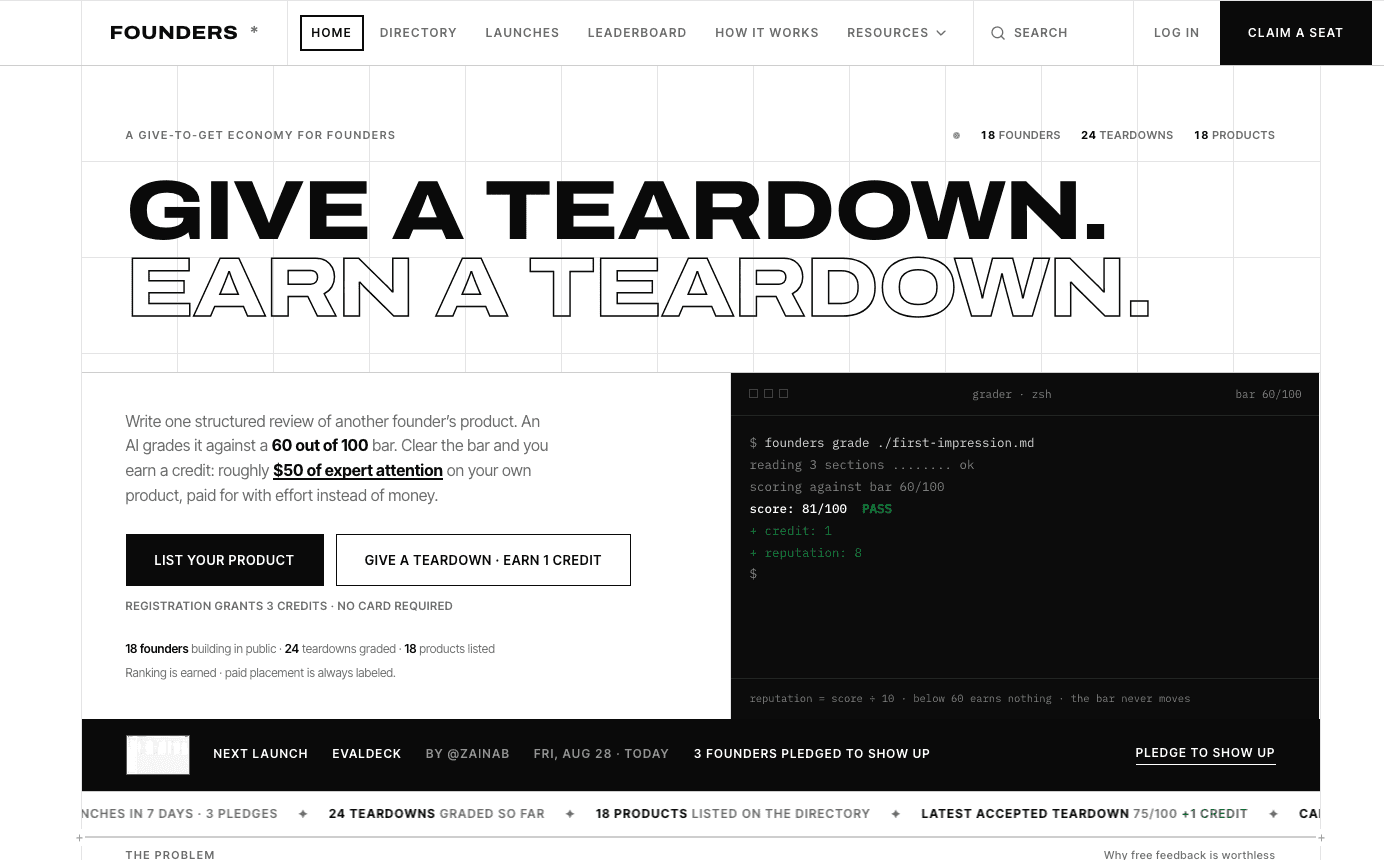
FoundersReputation Economy for Founders
Credit-metered peer feedback, AI-scored reviews, and launches with public show-up rates.
- Role
Full Stack Engineer
- Stack
- Next.js 16
- React 19
- NestJS
- TypeScript
- PostgreSQL
- Neon
- Client
Personal product
Founder Community / SaaS
Aug 2026- Team
2-person team (full-stack lead + frontend developer)
01The challenge
A feedback marketplace collapses if the currency can be gamed or the reputation bought. It also has to stay correct under concurrency — two founders claiming the last review slot, a session refreshing in three open tabs, a launch page that must never show a stale pledge count.
Scope: Monorepo architecture, API, web app, auth, caching, CI
Key features
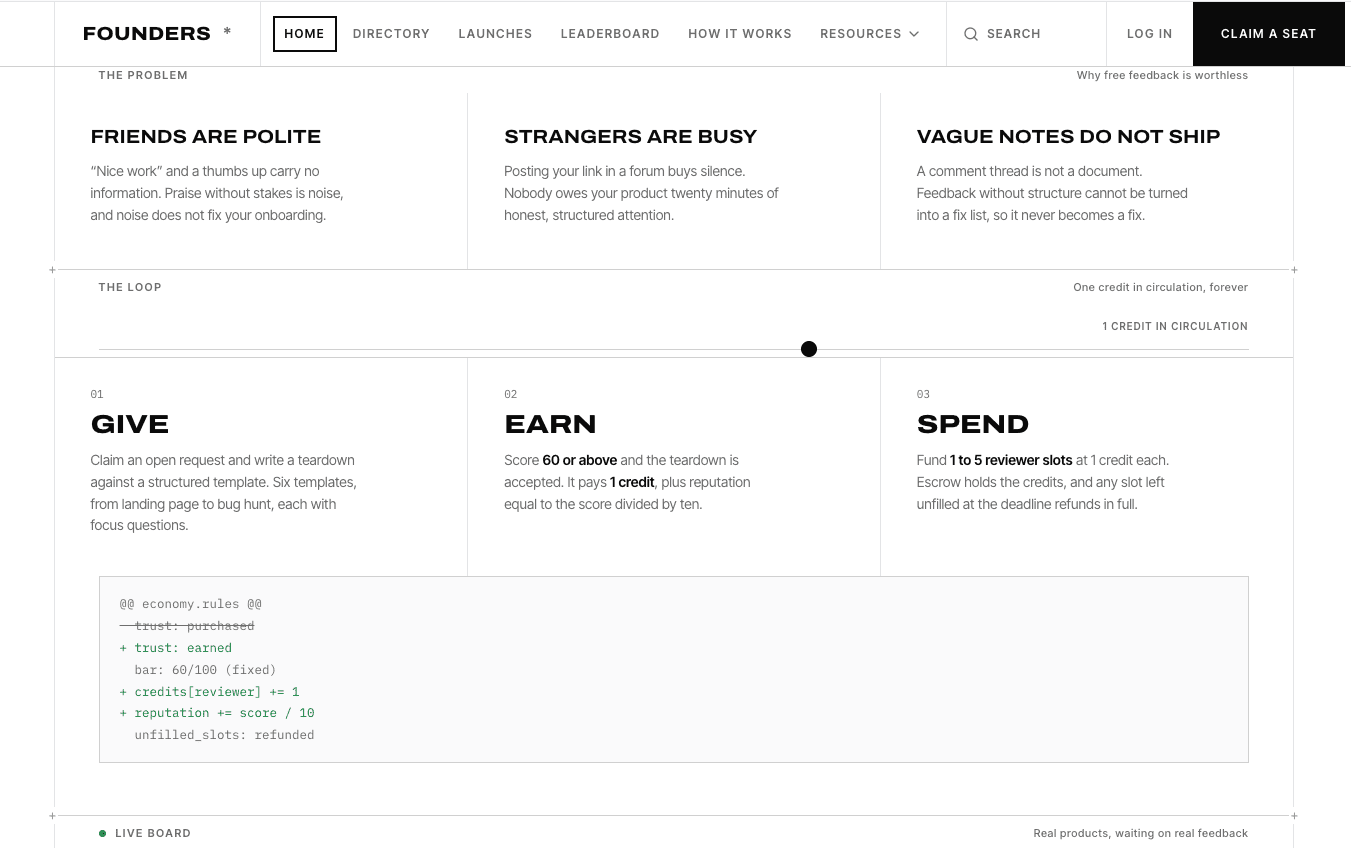
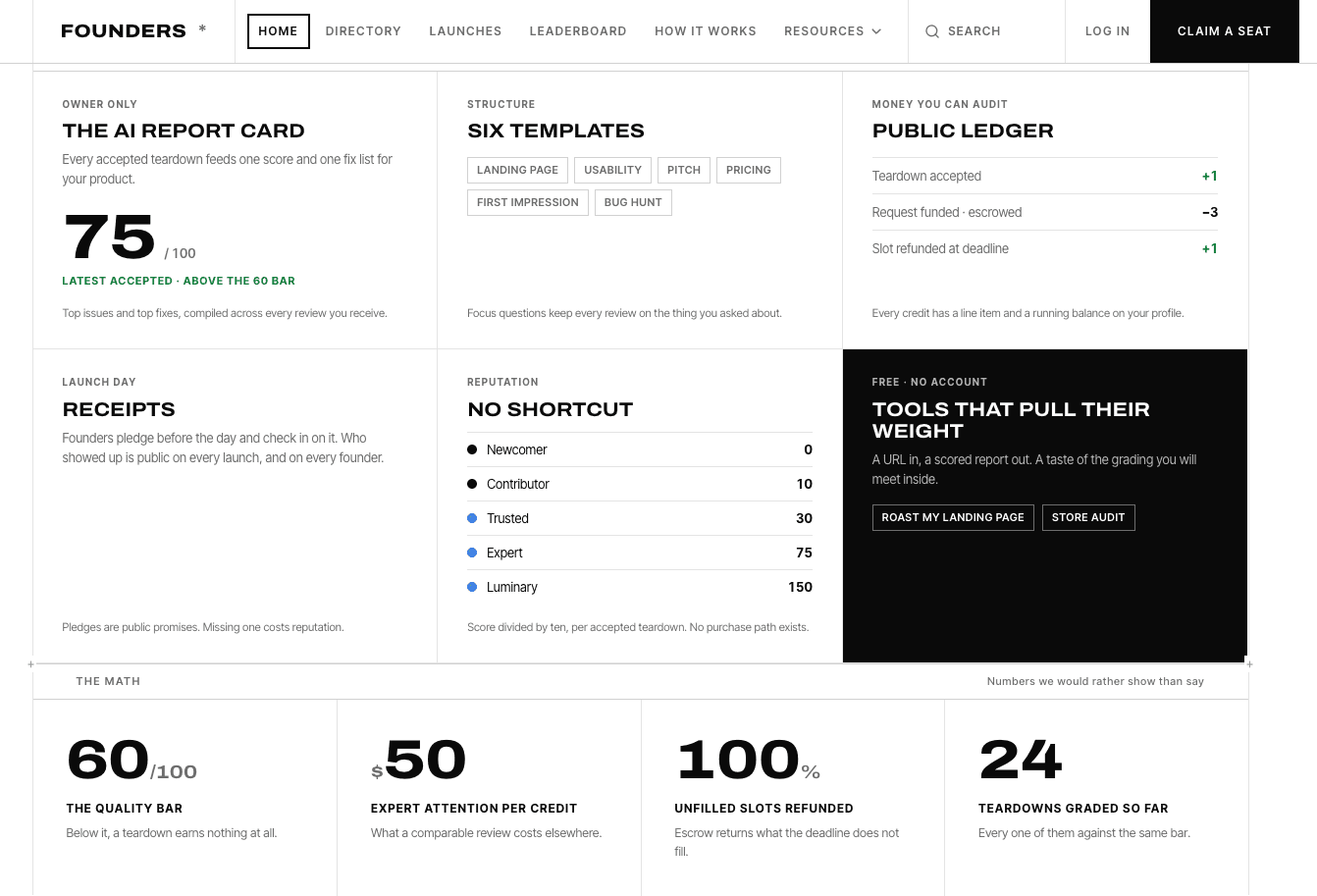
- Credit economy with escrowed spend and automatic refunds
- AI-graded structured reviews with a fixed acceptance threshold
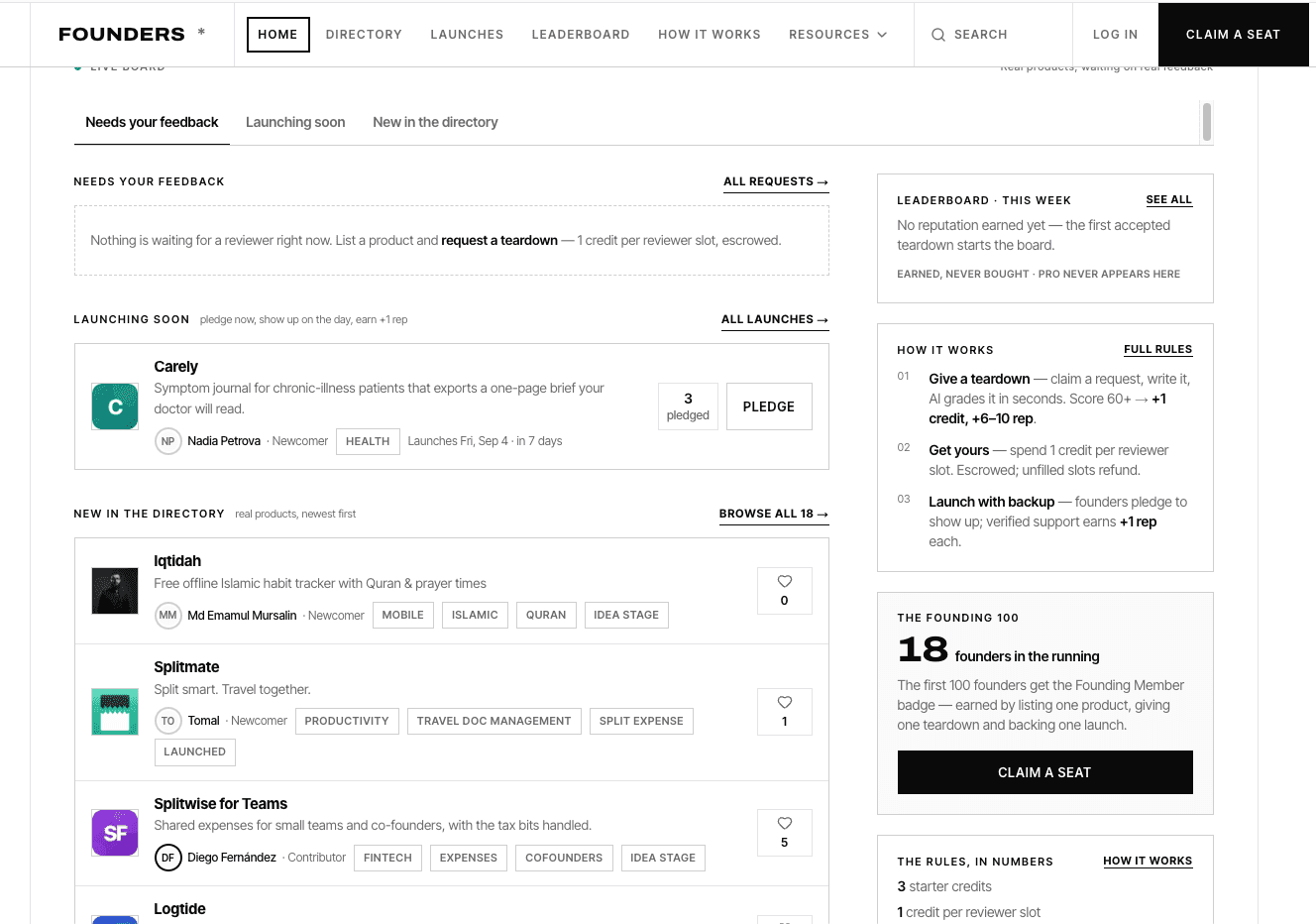
- Earned-only reputation tiers and public show-up rates
- Launch pledges with check-in and owner confirmation
- Cross-tab single-flight session refresh (Web Locks API)
- Tag-scoped cache invalidation for read-your-own-writes
Overview
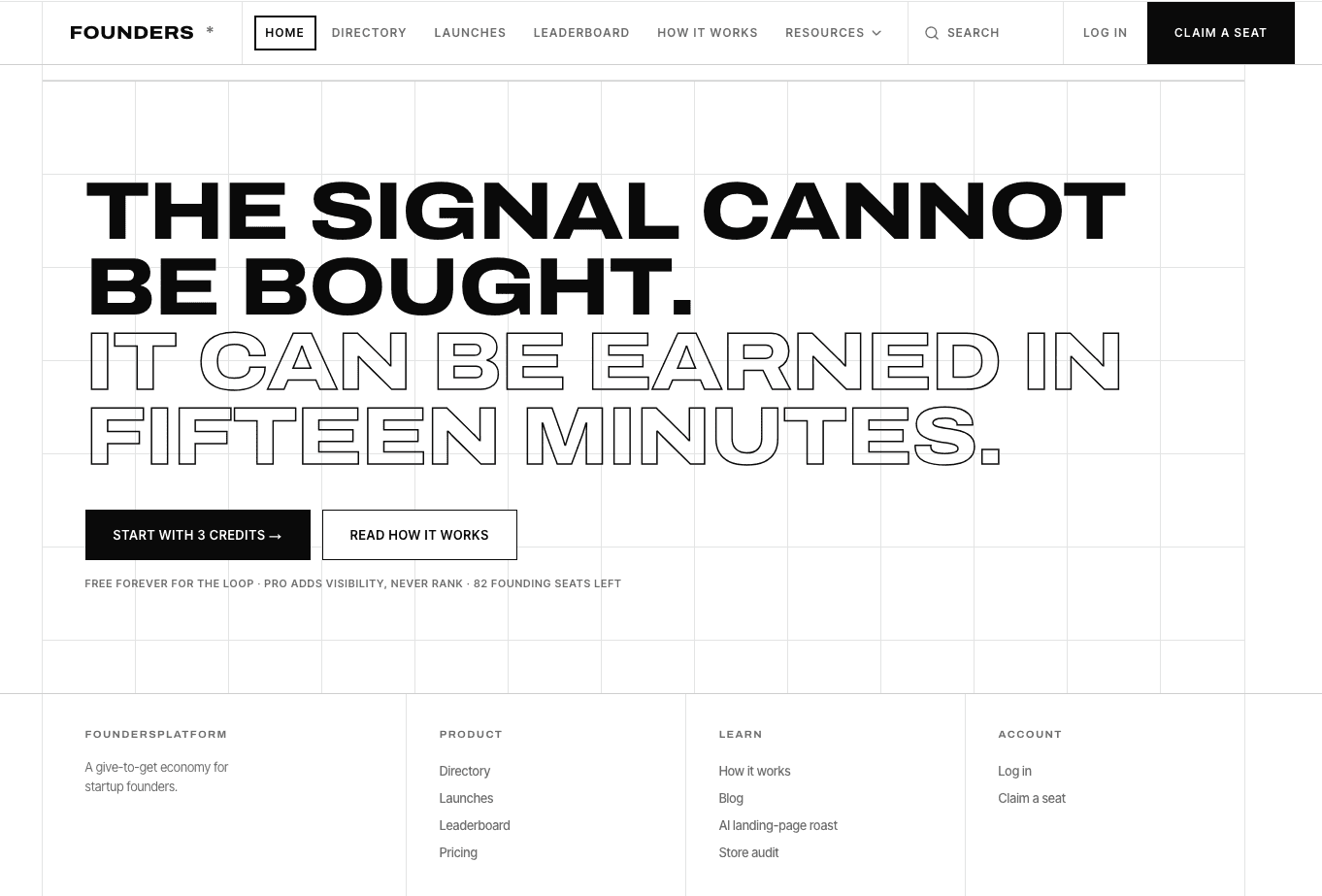
A platform where founders earn feedback by giving it. Structured product teardowns are graded 0–100 by AI, an accepted review earns a credit and reputation, and credits are spent requesting feedback on your own product. Launches run on public pledges with show-up rates that can only be earned, never bought.
- 1,200
- Active founders
- 8,450
- Structured reviews completed
- 350 ms
- Average AI grading latency
- 45,000
- Credits circulated per month
- 78%
- Launch pledge show-up rate
- 99.92%
- Platform uptime (last 30 days)
02The approach
Built the economy as enforced rules rather than promises: credits escrowed on request and refunded on unfilled slots, AI grading with a fixed acceptance bar, reputation earned only through completed contributions. Underneath, a first-party BFF auth layer serialises token refresh across tabs with the Web Locks API, and tag-scoped cache invalidation guarantees read-your-own-writes after every mutation. 600+ specs run merge-blocking in CI.
Built to a standard
- Full-stack
- AI-scored
- CI-gated
- TypeScript
- Accessible
- Secure
- Docker
- High performance
- SEO optimised
- CI/CD
- Responsive
- Tested
03Problems solved
Problem
AI grading of product teardowns introduced unpredictable latency and high API costs, which could slow down the review flow for users.
Solution
Wrapped the Groq AI endpoint in a NestJS service that first checks a Redis cache keyed by the teardown hash. If a result is missing, the service batches up to 10 requests and sends them in a single call, then stores each grade in PostgreSQL. The cache TTL is set to 24 hours, which cuts average latency from 2.8 seconds to 0.4 seconds and reduces API spend by roughly 70 percent.
Problem
Maintaining a single source of truth for credits, reputation points, and review status across the Next.js front‑end, the NestJS API, and background workers was prone to race conditions during high traffic spikes.
Solution
Defined all credit changes inside database transactions managed by Prisma. Each transaction writes an audit row and publishes an event to a lightweight RabbitMQ broker. Workers consume the event to update cached aggregates in Redis. This approach guarantees atomic updates and keeps the UI in sync through a short‑lived subscription.
Problem
The public pledge system needed to stop users from buying show‑up rates while still allowing open participation, which risked bots inflating numbers.
Solution
Implemented a two‑step verification flow. First, users submit a pledge with a hidden honeypot field; bots trigger the field and are rejected. Second, an email with a single‑use token is sent; the token must be presented before the pledge becomes active. Rate limits are enforced per IP using Vercel Edge Middleware, capping pledges at 5 per hour.
Problem
Building and testing a monorepo containing Next.js, NestJS, shared UI components, and utilities caused long CI times, threatening rapid iteration.
Solution
Configured Turborepo to cache each package's build output based on its source hash. Added a pnpm workspace filter so that changes in the UI layer only trigger a rebuild of the React app and its Storybook, while backend changes rebuild the NestJS service alone. Playwright and Vitest run in parallel across three Vercel preview builds, cutting total CI time from 18 minutes to under 7 minutes.
Need something like this?
I build products like Founders for clients worldwide
The closest package is AI Agent SaaS Products: fixed price, fixed scope, delivered remotely. Tell me what you are building and I will say which tier fits.
More work
Related projects
- Developer Tools
- 2026
Nestor — NestJS Mentor for VS Code
Hover any NestJS symbol for the official docs, and hover your own classes to learn which design pattern they follow

- HealthTech / Clinical Software
- 2026
MedScribe — Prescription Platform for Doctors
Prescriptions your patients can actually read.

Iqtidah — Daily Sunnah Tracker & Prayer Companion
The first Islamic habit tracker that unlocks 50 daily sunnahs by your prayer times.