In Progress
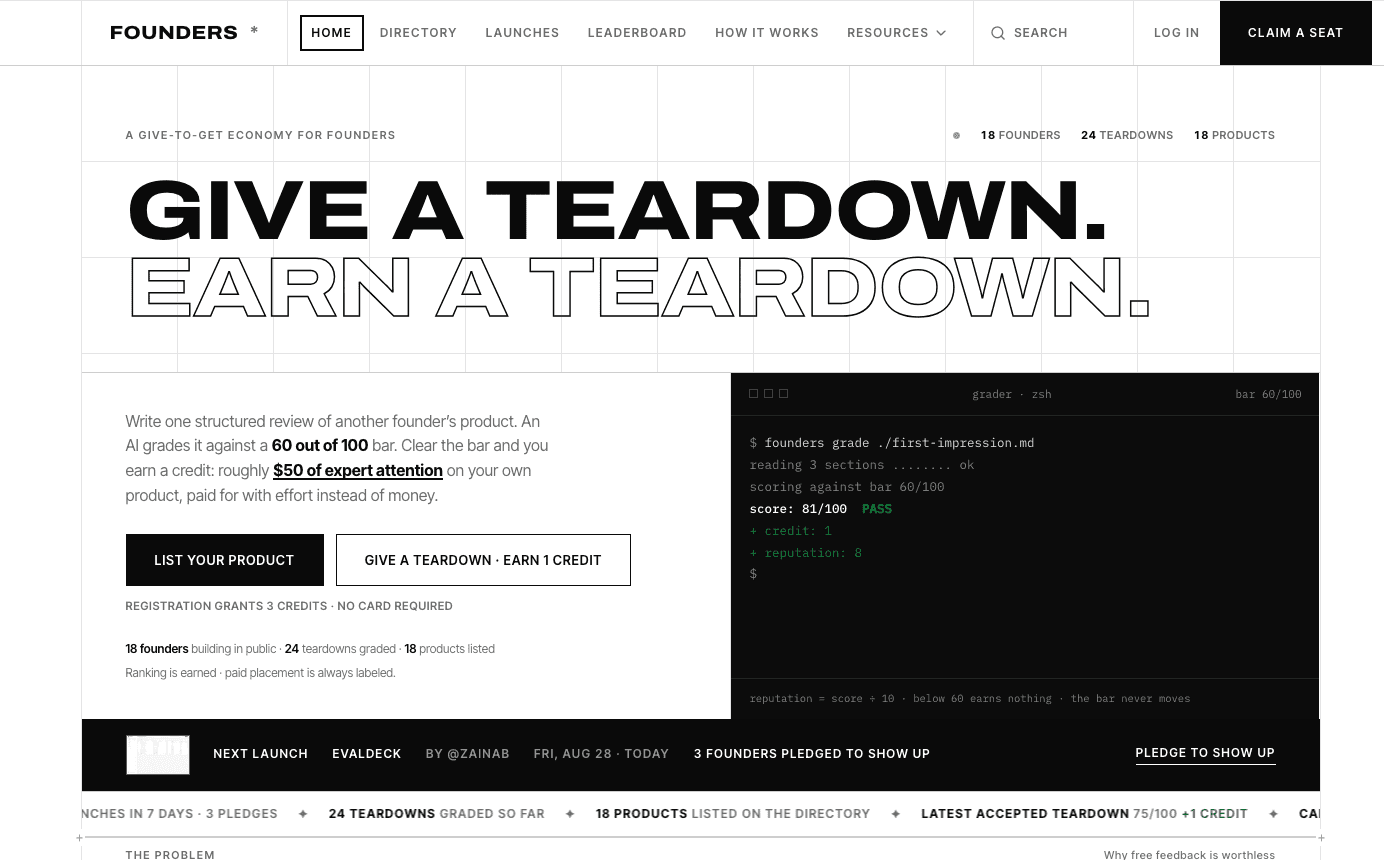
Founders — Reputation Economy for Founders
Credit-metered peer feedback, AI-scored reviews, and launches with public show-up rates.
Next.js 16React 19NestJS+11
Hover any NestJS symbol for the official docs, and hover your own classes to learn which design pattern they follow
A VS Code extension that turns the editor into a NestJS mentor. It ships 136 pages of the official NestJS documentation and an index of ~800 Nest symbols fully offline, so hovering ThrottlerModule, @SkipThrottle or ValidationPipe shows the relevant docs excerpt inline. Hovering your own class declarations runs a Gang-of-Four pattern analysis — identifying the pattern, your role in it, and how well the implementation follows it — with an optional Groq-powered verdict for harder cases.
NestJS developers constantly tab out of the editor to look up decorators, modules and pipes on docs.nestjs.com, and newer developers rarely know whether the class they just wrote is a proper Strategy, Decorator or Factory — or a half-finished one. Existing tooling offers autocomplete but no explanation, and AI assistants require sending code to the cloud for every question. The goal was an in-editor mentor that works offline by default, only speaks when it is confident, and adds AI as an opt-in layer rather than a requirement.
The extension bundles a snapshot of the NestJS documentation (136 markdown pages) plus a generated index of roughly 800 symbols exported from @nestjs/* packages. Hover resolution goes through VS Code's TypeScript language server rather than regex matching, so a symbol only produces a hover when it genuinely resolves to a Nest import — eliminating false positives on same-named user code. A side-panel webview renders full documentation pages and powers a Ctrl+Alt+N search across pages and section headings. Design pattern detection is a two-tier system: a static rules engine analyses class syntax, naming conventions and sibling classes/interfaces to classify Gang-of-Four patterns with a confidence level and role (e.g. ConcreteDecorator), and an optional Groq integration (openai/gpt-oss-120b by default) provides an AI verdict for ambiguous cases, cached per workspace and bounded by a hover timeout so the editor never stalls. Privacy was a design constraint: no network calls are made until a user stores an API key, and node_modules, .d.ts files and oversized classes are never transmitted.
Naive text matching produced hovers on any identifier that happened to share a name with a Nest export, e.g. a user's own Logger or Injectable helper.
Routed symbol resolution through VS Code's built-in TypeScript server and only show a hover when the symbol's definition resolves to an @nestjs/* module. Exposed this as the nestor.hover.requireNestImport setting so users can loosen it if they want.
Pattern detection had to be useful without a type checker or a network connection, yet an AI opinion is genuinely better for ambiguous classes.
Built a static rules engine that works from syntax, naming and sibling declarations and reports a confidence level, then layered Groq as an optional second opinion. AI results are cached per workspace, gated behind a configurable minimum confidence, and bounded by a 2s hover timeout so the editor stays responsive.
Sending user source code to a third-party API is a trust problem for a developer tool.
Made AI strictly opt-in (nothing leaves the machine until a key is stored), excluded node_modules and .d.ts files, capped class size at 12,000 characters, and documented exactly what is transmitted and to which host in the README.
Need something like this?
The closest package is AI Integration & Automation: fixed price, fixed scope, built from Rajshahi, Bangladesh and delivered remotely. Tell me what you are building and I will say which tier fits.
Credit-metered peer feedback, AI-scored reviews, and launches with public show-up rates.

Prescriptions your patients can actually read.

The first Islamic habit tracker that unlocks 50 daily sunnahs by your prayer times.