

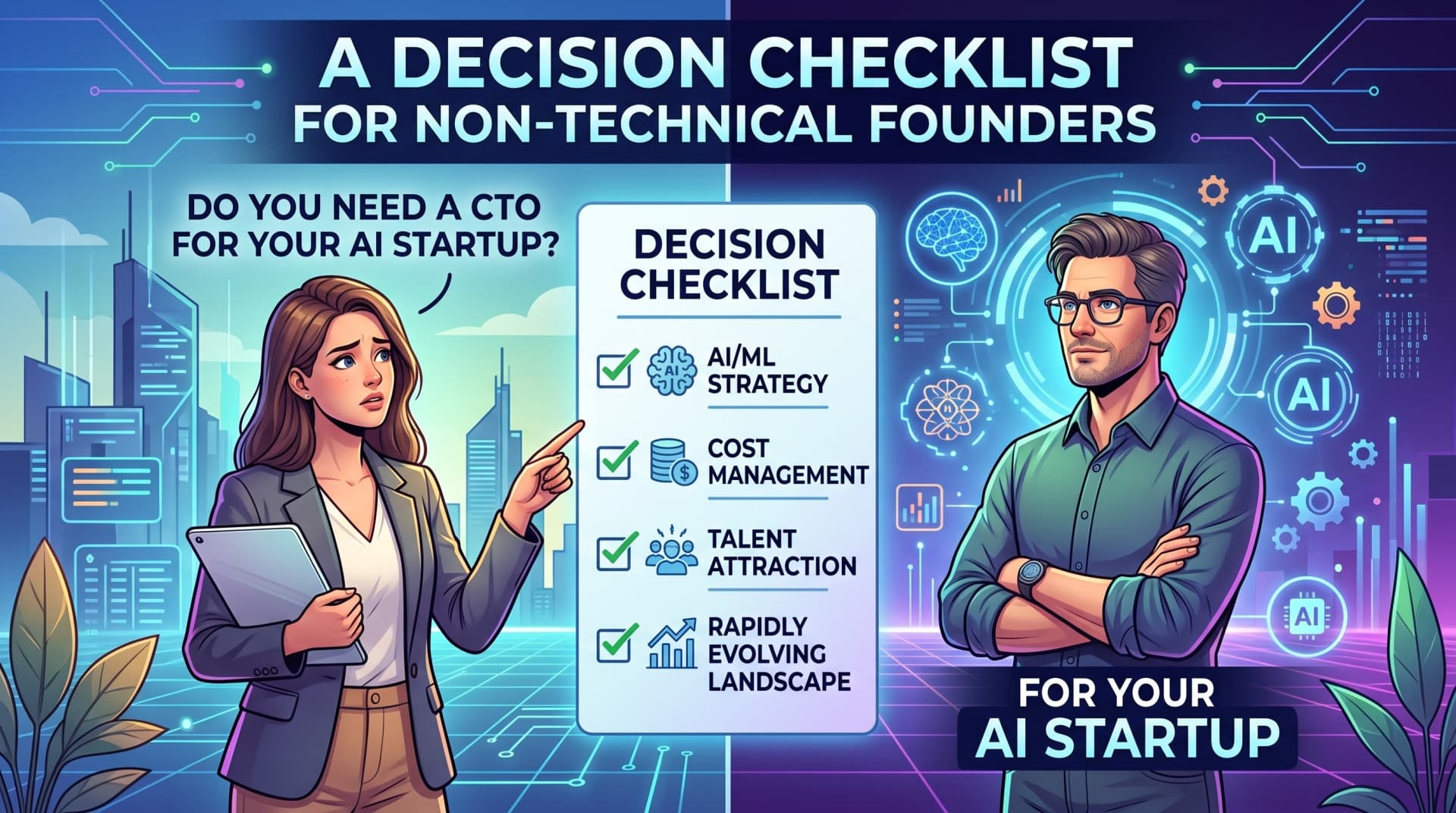
Do You Need a CTO for Your AI Startup? A Decision Checklist for Non-Technical Founders
- By Md. Emamul Mursalin
- Updated
- 10 min read
If you are asking "do I need a CTO for my AI startup," the honest answer for most pre-seed and seed companies is: not a full-time one, not yet. What you need is someone senior enough to make a handful of irreversible technical decisions correctly and to ship a product that proves the idea. I am Md. Emamul Mursalin, a freelance AI product developer in Rajshahi, Bangladesh. I have been that person for non-technical founders in the US, UK, and EU, and I have also told founders they needed a real CTO instead of me. This checklist is how I decide.
What a CTO is for at each stage
The title covers three different jobs depending on stage, and confusing them is where founders waste money.
Stage | What "CTO" actually means | Who can do it |
|---|---|---|
Idea to MVP (pre-seed) | Pick the stack, build the first version, control AI costs, avoid dead ends | Senior developer with product experience, fractional CTO |
MVP to product-market fit (seed) | Architecture that survives growth, first hires, security, investor diligence | Fractional CTO, technical co-founder |
Scaling (Series A+) | Engineering org, hiring 10+, process, culture, board presence | Full-time CTO or VP Engineering |
At the first stage, a full-time CTO is mostly a very expensive senior developer with a title. At the third stage, a senior developer is out of their depth. The trick is to name which stage you are in and hire for that, not for the stage you hope to reach.
The five decisions that actually need a senior technical person
For an AI startup specifically, there are five choices that are painful to reverse. Whoever makes them needs real experience, whether their title is CTO or not.
Which model provider and how to abstract it. Locking your product to one vendor's API in 2026 is a mistake; the models change every few months. A thin provider layer that lets you switch between OpenAI, Claude, and Groq is a week of work early and months of work late.
Where your data lives and how it is scoped. If you are multi-tenant (most B2B AI products are), tenant isolation must be designed in from the first table. I explain why in How I Build Multi-Tenant AI Agent SaaS.
How you measure whether the AI works. Without an eval set, every prompt change is a gamble. This is the decision most first-time founders skip, and it is the one that later makes fundraising demos fail.
What your unit economics look like. Token costs per user per month decide whether your pricing can ever work. Someone needs to model this before you commit to a plan.
Build vs buy for everything else. Auth, billing, email, vector search: buy them. A senior person knows which "buy" options are safe and which will trap you.
If you have someone who can make those five calls with confidence and defend them to an investor, you have what you need for now, whatever their title.
The decision checklist
Answer each question honestly. Score one point for each "yes."
You have raised, or will raise within six months, more than $1.5M
You need to hire and manage three or more engineers in the next year
Investors have told you a technical co-founder is a condition of the round
Your product is regulated (health, finance, legal) and needs a named accountable owner
Your core differentiation is a model or algorithm you must build yourself, not a product built on hosted models
You have a real technical co-founder candidate you have already worked with
You need someone in your time zone for daily in-person collaboration
Your AI feature already has paying users and is breaking under load
You need technical due diligence support for an acquisition or a large enterprise deal
You can afford $150,000+ in salary plus equity, or $8,000-15,000 a month in retainer
You have exhausted what a senior developer plus a part-time advisor can do
You personally cannot evaluate whether technical advice is good and need a trusted long-term owner
0-3 points: You need a senior developer with product judgment, possibly with a light advisory layer. Build the MVP, get users, revisit in six months.
4-7 points: You need a fractional CTO: someone accountable for architecture and technical decisions at 10-20 hours a week, while a developer (or the same person) ships. This is where most seed-stage AI startups sit.
8-12 points: Hire a full-time CTO or bring on a technical co-founder. A fractional arrangement will not carry the weight.
The three options and what they cost in 2026
Option 1: Senior developer with product experience
For an idea-stage company, this is often enough. A senior full-stack AI developer builds the MVP, makes the five decisions above, and hands you a working product with cost dashboards and evals in place. Offshore, that is $3,000-8,000 for a 4-6 week MVP; the same from a US agency is $40,000-80,000. I cover the numbers in detail in MVP Development Cost in Bangladesh 2026.
The risk: a developer who is good at building may not be good at telling you what not to build. Ask them what they would cut from your roadmap. If the answer is "nothing," keep looking.
Option 2: Fractional CTO
A fractional CTO is accountable for technical direction without a full-time salary. US and UK operators charge $5,000-15,000 a month for 10-20 hours a week; offshore senior engineers with the same responsibilities charge $2,000-5,000. I break this down in Fractional CTO Cost in 2026.
In my experience the fractional model works best when the same person also writes code. Strategy documents from someone who no longer builds tend to underestimate how long things take and overestimate how much the team can absorb. The engagements I run under AI Strategy & Fractional CTO are structured as an audit and roadmap first, then an embedded retainer, precisely so the plan is tied to someone who will implement it.
Option 3: Full-time CTO or technical co-founder
Full-time salaries for a startup CTO in the US run $150,000-250,000 plus significant equity; a technical co-founder typically takes 20-40% of the company. That is the right price when you are managing a team and raising institutional money. It is a heavy price to pay for someone to build your first prototype, and founders who give away a third of the company for an MVP tend to regret it when the first version has to be rewritten anyway.
Mistakes I see non-technical founders make
A short list from the calls I take.
Hiring a CTO to get credibility, then having nothing for them to lead. A CTO with no team and no product spends their time building, which a senior developer would do for a fraction of the cost.
Choosing an agency because it feels safer. Agencies rotate junior developers through your project. You want one senior person who is accountable and whom you can actually talk to.
Believing the AI is the hard part. In most AI startups, the model call is 10% of the code. The other 90% is a normal SaaS, and normal SaaS is where projects die.
Not owning the accounts. Whoever you hire, the GitHub organization, cloud account, App Store account, and model provider keys must be yours. Contractors get collaborator access. I set every client up this way by default.
Skipping the contract. A short independent contractor agreement with IP assignment and confidentiality is enough. Without it, you may not own your own product.
How founders work with me in this role
Founders who land in the 4-7 point range often bring me on as an offshore fractional CTO who also ships. The arrangement is simple: I do a paid audit first (the starter tier, 1-2 days), then a roadmap (the professional tier, two weeks), and only then do we decide on a retainer. The Founders Platform started exactly this way: a founder with a clear vision, no technical partner, and a need for someone to make architecture decisions and then build them.
Working remotely from Bangladesh is a feature, not a limitation, once communication is set up properly. My working hours overlap with US evenings and early mornings and the full UK and EU afternoon. Decisions happen in written form, which means you have a record of every architectural choice and why it was made. Payments are by Payoneer or bank wire under a contract that assigns IP to you. The details are on my fractional CTO for AI startups page.
Do I need a CTO for my AI startup? The short version
To answer "do I need a CTO for my AI startup" directly: at idea and MVP stage, no. You need a senior person who can make the five irreversible decisions well and ship a product that proves demand. From seed onward, you need someone accountable for architecture and hiring, which a fractional CTO covers at a fraction of a full-time cost. At Series A, when you are building a team of ten, hire the full-time CTO. Run the checklist, score yourself honestly, and hire for the stage you are in.
FAQ
Do I need a CTO for my AI startup?
Not at idea or MVP stage. A senior developer with product experience can make the key decisions (model provider abstraction, tenant-scoped data, evals, unit economics, build-vs-buy) and ship the first version. You need a fractional CTO from seed stage, and a full-time CTO when you are managing a real engineering team.
When should a startup hire a fractional CTO?
Hire a fractional CTO when you have a product with users, are about to raise or have raised a seed round, and need someone accountable for architecture, security, hiring, and investor diligence, but cannot justify a $150,000+ salary. Typically that is the window between first revenue and the first three engineering hires.
Can a fractional CTO replace a technical co-founder?
For 12-18 months, usually yes. A fractional CTO makes the same architectural and hiring decisions without taking 20-40% equity. What they do not provide is founder-level commitment. If investors require a technical co-founder, use the fractional period to find a strong one rather than settling for whoever is available.
What does a fractional CTO do?
A fractional CTO owns technical direction part-time: choosing the stack and AI architecture, reviewing code and security, hiring engineers, controlling infrastructure and model costs, and representing the company technically to investors and enterprise customers. Good ones still write code. Typical commitment is 10-20 hours a week on a monthly retainer.
Fractional CTO vs technical consultant: what is the difference?
A consultant delivers an answer to a defined question, usually as a fixed-price project, then leaves. A fractional CTO is retained over time and accountable for outcomes: shipping, hiring, and architecture. Start with a consultant-style audit and roadmap, then convert to a fractional retainer if the fit is right.
Work with me
If you are a non-technical founder trying to answer this question for your own company, book a call and I will tell you where you land on the checklist, including if the answer is "hire a full-time CTO." If you already know you need a roadmap, start with the professional tier.
Written by
Md. Emamul Mursalin
Free consultation
Building something like this?
I'm a freelance AI product developer in Rajshahi, Bangladesh, working remotely with clients worldwide. A free 30-minute call is enough to scope it.
Book a free 30-min callKeep reading
Related articles

- Hiring Guides
- 12 min read
Code Audit Cost in 2026: Real Prices From $249 to $20,000 and What Each One Buys
A code audit costs anywhere from $249 to $20,000+ in 2026. Here are published prices from real providers, what drives the number, and how to pick the tier you actually need.
- Developer Tools
- 10 min read
Best VS Code Extensions for NestJS in 2026: 13 That Earn Their Place
The VS Code extensions I actually run on NestJS projects in 2026, with install counts, what each one does, which popular ones are abandoned, and a copy-paste extensions.json.
- Developer Tools
- 11 min read
Nestor: A NestJS VS Code Extension That Puts the Docs and Design Patterns on Hover
Nestor is a free NestJS VS Code extension: 136 pages of official docs on hover, fully offline, plus Gang of Four pattern detection for your own classes. Here is what it does and why I built it.